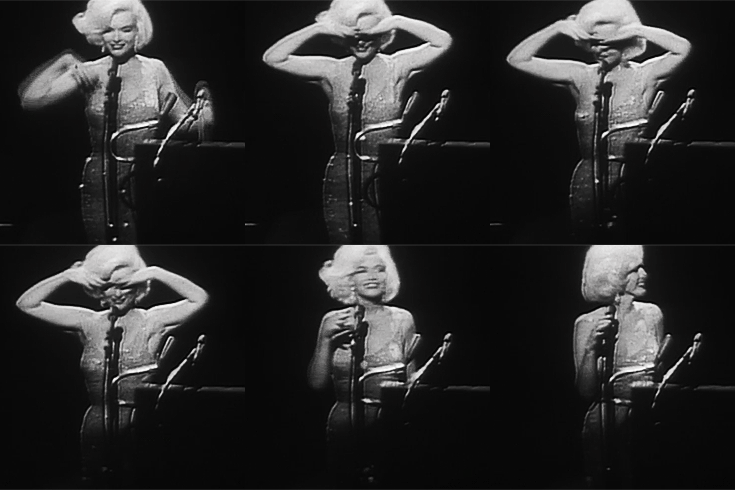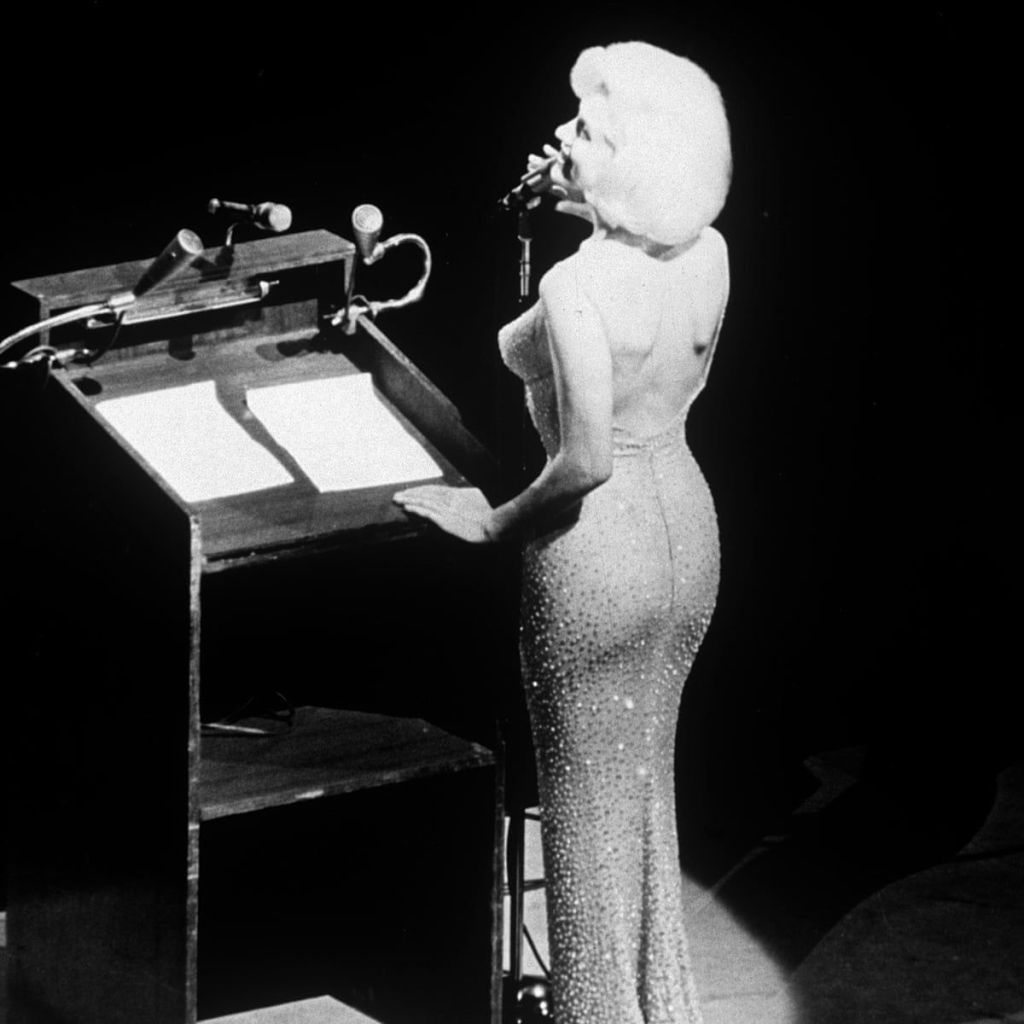
Everyone knows that moment when Marilyn Monroe sang her sensual rendition of “Happy Birthday to You” to John F. Kennedy at Madison Square Garden, but I think there was something kind of significant about that moment’s impact on pop culture and the media, because while Hollywood stars and politicians have always mingled in the same circles in similar places in the past, I can’t really think of anything like this specific moment that came before, but I can think of a lot of moments like it that have happened since.
The scene: Manhattan in the spring of 1962. President John F. Kennedy’s birthday is in a few days but he decides to celebrate it early and use it as an opportunity for a star-studded fundraising gala. Right before the giant cake is brought out, JFK is serenaded by one of the most famous and beautiful Hollywood stars of that time, Marilyn Monroe, who is wearing a sexy, sparkling gown before she goes on stage and sings an equally sexy version of “Happy Birthday to You” to the president. The way that she was lit on that stage almost made her dress see-through, which made some people in the audience gasp. JFK was quite possibly experiencing the best thing that any heterosexual man can experience in his life from the most objectified woman in Hollywood, jokingly remarking afterward that he could now retire from politics.
The way that the controversy-addicted tabloid media reacted to that moment made it seem as though Marilyn Monroe was doing something pretty scandalous here, especially since JFK had a wife and kids who were elsewhere while this was taking place. Of course, it’s not like Monroe did this on a whim. That gown she was wearing was designed especially for this event by leading fashion designer Jean Louis, based on a sketch by Bob Mackie. And I suspect the people behind this gala allowed her to wear that dress because they knew the event would get even more attention that way. Because don’t forget that this was not just JFK’s birthday celebration. It was a Democratic Party fundraising event. Basically, my theory is that the shock value of that moment was the point.
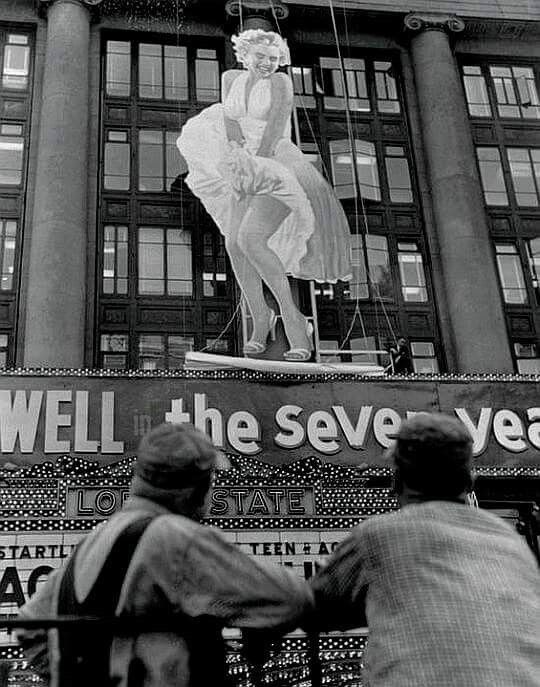
Hollywood has always tried to use shock value, sex and taboo subject matter to lure audiences into the theater. The concept of the peep show was sold around this very idea in the 1800s. But in perhaps not such a coincidental earlier moment in Marilyn Monroe’s career, 20th Century Fox took the idea of shock value to another level when Billy Wilder adapted the George Axelrod play The Seven Year Itch and all the advertising and publicity surrounding that film practically sold it as the movie where Marilyn Monroe gets her skirt blown up by a subway grate. That was the film’s main selling point, and it worked! Given that precedent, I would not be surprised if the people in charge of that gala at Madison Square Garden wanted to use Marilyn’s sex appeal for their own gain in a similar way.
I know every time I write about Marilyn Monroe in this blog I love to speculate and theorize about her, but I’m just typing my inner thoughts (and I also just love talking about her). Although there is a broader point I’m making about this whole thing. The moment when she sang to JFK in that gown feels kind of like a symbol of a postmodern cultural shift from relegating shock value to literature, theater and radio to blending shock value with reality. In those days, seeing Marilyn Monroe sing this way to the president of the United States was practically the equivalent of seeing Madonna kiss Britney Spears at the VMAs or seeing Janet Jackson get exposed at the Super Bowl, the fact that reality television as it exists today was not a thing back then making it even more impactful. Shock value sells, and this was just an early example of the media exploiting something that they slowly became less ashamed of exploiting as the years went by.
Just FYI, what I’m talking about is a different thing than shock value in fiction. When you intentionally push buttons, provoke controversy or do something widely perceived as offensive in the art world, this is called transgressive art. A term coined in the 1980s by Nick Zedd, a filmmaker who led the Cinema of Transgression movement, an underground low-budget film movement that began in New York City and reveled in black humor, perversion, sex, grotesquerie and, of course, shock value (Pink Flamingos director John Waters kind of helped inspire that movement while independent filmmakers like Quentin Tarantino, Jim Jarmusch and James Gunn fully embraced it, as well as studios like Troma). There is also a thing in music called Shock Rock, a term coined in the sixties to describe shocking and subversive musicians like Frank Zappa and would later be applied to people like Alice Cooper, Iggy Pop, Kiss and Slipknot, although even as early as the 1950s, musicians like Screamin’ Jay Hawkins (“I Put a Spell on You”) would perform crazy stunts on stage like emerging from a coffin right before he started singing. Now Hawkins is considered a Shock Rock pioneer.
Cinema of Transgression and Shock Rock are two of the most pure forms of shock value culture in an artistic sense. But there is also a more tame mainstream version of it that can be seen in monster movies, horror movies, movies with gross-out humor like American Pie and exploitation films of the low-budget variety that used to be common in drive-ins and grindhouse theaters, and not to mention modern reality television, which practically thrives on it, as well as The Jerry Springer Show, South Park, shock jock Howard Stern and a ton of stand-up comedians like Sam Kinison, Jeff Ross, Sarah Silverman, Ricky Gervais and Sarah Squirm. Even fashion models use shock value to make an impression with their clothes. And sometimes the lack of clothes is the shocking statement, like when Kim Kardashian tried to “break the internet” by going full frontal nude on the cover of Paper Magazine in 2014. Funny enough, Kardashian wearing the actual gown that Monroe wore when she sang “Happy Birthday” to JFK was another example of using shock value to get attention.

Shock value culture is also prolific in many spheres on the internet with shock sites and intentionally offensive and disturbing videos (2 Girls 1 Cup is a famous example) and especially among the trolls of social media. And speaking of trolls, I also suspect shock value culture is a big reason why Donald Trump is popular with so many Americans, because the reality show host and WWE Hall of Famer is pretty much a fountain of shocking statements and controversial takes. Not only is that why people are entertained by him but it’s why the media is obsessed with him, and the fact that he acts more like a wannabe dictator than a president sadly feeds into this.
Shock value is seen as an important ingredient of the modern media landscape right now because people knows that it’s the cheapest way to get eyeballs. It’s often how they grab attention with their headlines, posters, movie trailers, TV ads and live performances. Whether Marilyn Monroe was being used that night or using the publicity from that night for her own benefit or whatever it was doesn’t really matter. She pushed boundaries and kind of became the poster child for shock value when she did this, inadvertently giving the media permission to embrace controversy rather than avoid it in the name of holding up the pillars of good taste. Pillars that have slowly crumbled away as society slowly became more drawn to what you are NOT allowed to do.