

As I said in my article “The History of SNL in the Seventies,” showrunner Jean Doumanian had a Herculean task ahead of her trying to fill the shoes of Lorne Michaels in the fall of 1980, as the new driving force behind the sixth season of a show that by this point is already a pop culture phenomenon. Although Saturday Night Live also had a reputation for being a springboard to fame thanks to films like Animal House, and that meant that there were many comedians who were willing to join the show as cast members. But there were still challenges. Doumanian only had three months to hire new cast members and new writers, NBC cut the show’s $1 million-per-episode budget down to less than half, many remaining staffers resented Doumanian for taking Lorne’s place, and then there was the very real and imminent threat that television viewers would completely reject this new overhauled version of the show.

The season premiered on November 15, 1980 with new cast members Denny Dillon, Gilbert Gottfried, Gail Matthius, Joe Piscopo, Ann Risley and Charles Rocket with Matthew Laurance, Eddie Murphy, Patrick Weathers and Yvonne Hudson joining the cast later that season. Despite the talent and the potential, this season was, perhaps unsurprisingly, widely despised by audiences who failed to connect with the new cast, and by critics who found it overwhelmingly unfunny. To this day, it is still considered by many to be SNL‘s worst season. In fact, due to how low the ratings sank (and possibly because Charles Rocket said “fuck” live on the air), Doumanian was fired from her job as executive producer and showrunner in 1981 after only ten episodes!
Brandon Tartikoff, the president of NBC’s entertainment division, decided to replace Jean Doumanian with Dick Ebersol, the man who first hired Lorne Michaels to create SNL. Ebersol would retool the show in 1981 by firing Gilbert Gottfried, Yvonne Hudson, Matthew Laurance, Ann Risley, Charles Rocket and Patrick Weathers, all of whom would leave the show by Episode 12 with Gail Matthius and Denny Dillon leaving after the season ended and Eddie Murphy and Joe Piscopo being the only cast members to survive for the next season. Episode 13 was Dick Ebersol’s first episode as showrunner, and due to the 1981 writer’s strike it was also the last episode that season (which may have been a merciful blessing).
Despite some network executives suggesting SNL be cancelled, Tartikoff found value in the show as an institution that was beyond monetary, so he gave it another chance. Although once Season 7 began in 1982 with Ebersol in full control, while you could tell that it was better than the previous season, you could also tell that Ebersol’s taste in humor was more broad and lowbrow than Lorne’s, and some fans felt betrayed by this shift in the show’s style, especially when it avoided political humor. Many people credit Eddie Murphy for saving SNL, and for good reason. This may not have been a highpoint for SNL but it was definitely a high point for Murphy’s career. Thanks to films like 48 Hrs., Trading Places and Beverly Hills Cop, Eddie Murphy was one of the biggest movie stars on the planet in the eighties. Simultaneously he was one of the funniest cast members of the Ebersol era, and to this day he is still highly regarded as one of the best cast members in the show’s history. Which meant that a lot of people definitely watched SNL during this time, despite the lag in quality.

During Ebersol’s run the show introduced new cast members like Tim Kazurinsky, Mary Gross, Christine Ebersole, Robin Duke and Tony Rosato in 1981, Julia Louis-Dreyfus, Brad Hall and Gary Kroeger in 1982 and Jim Belushi in 1983, but after Eddie Murphy’s departure in 1984, Ebersol broke a tradition and decided to hire established comedians to join the cast when sitcom star Billy Crystal, SCTV cast member Martin Short and This Is Spinal Tap star Christopher Guest joined the cast of Season 10 alongside Fridays and Not Necessarily the News star Rich Hall and New Zealand-born star of British television Pamela Stephenson (Christopher Guest’s Spinal Tap co-star Harry Shearer also rejoined the cast that year). This season is considered one of SNL‘s funniest, despite how far it strayed from Lorne’s vision.

As it turned out, the fans were right. Dick Ebersol was not the right person to run this kind of show. After the last episode of Season 10 aired in 1985, every single cast member left the show with several being reluctant to endure the show’s demanding production schedule any longer. If NBC had agreed to Ebersol’s request to put the show on hiatus to give him time to rebuild and recast, and if they had done what he wanted by eliminating the live television aspect (yes, Ebersol wanted a show called “Saturday Night Live” to stop airing live), then Ebersol might have continued running the show. But NBC rejected all these proposals and decided to do what many SNL fans wanted them to do: bring back Lorne Michaels.
During his hiatus from SNL in the early eighties, Lorne Michaels had very little success in show business. He continued to pursue his love for sketch comedy when he created The New Show for NBC in 1984, but despite some impressive guest stars, that show lasted only nine episodes before getting cancelled. Despite putting SNL behind him, the show was still Lorne’s baby and he was eager not to see it get cancelled. That (plus the fact that he was broke and needed money) is what persuaded him to return to SNL as executive producer and showrunner in the fall of 1985.
It would be a nice and clean feel good story if I said that SNL immediately became funny again and everything went back to normal once Lorne Michaels returned, but even with Lorne back, the tone of the show still did not feel quite right.
The decision Ebersol made last season to bring established stars like Crystal, Short and Guest into the cast inspired Lorne to continue that trend and hire more established comedy stars. Particularly younger stars who in Lorne’s mind would take SNL into the next generation by appealing to younger viewers. These new cast members included Joan Cusack, Robert Downey Jr., Nora Dunn, Anthony Michael Hall, Jon Lovitz, Dennis Miller, Randy Quaid, Terry Sweeney, Danitra Vance and Damon Wayans (Dan Vitale would also join the cast as a featured player later that season but only for two episodes).

Each of these actors and comedians on their own are talented individuals, but as a sketch comedy team? It was an awkward grouping of people and it just didn’t work. For one thing, writers found it difficult to write sketches for this cast (who the heck is Anthony Michael Hall going to play in a political sketch??) The problems showed in the very first episode of the season, which got negative reviews and has gone down in history as one of the show’s worst episodes. The entire season wasn’t bad. Many people thought cast members Jon Lovitz and Dennis Miller were the comedic highlights. But even Brandon Tartikoff started to consider cancelling SNL, and he may have done so had Hollywood agent Bernie Brillstein not convinced him to let the show have one more year. The compromise would be that NBC would only renew the show for 13 episodes (instead of the usual 22).
With Lorne Michaels being given another chance to turn the ship around and prove himself, he fired Joan Cusack, Robert Downey Jr., Anthony Michael Hall, Randy Quaid, Terry Sweeney and Danitra Vance (Damon Wayans was fired earlier that season), he kept on Nora Dunn, Jon Lovitz and Dennis Miller and for the next season he hired Dana Carvey, Phil Hartman, Jan Hooks, Victoria Jackson and Kevin Nealon.
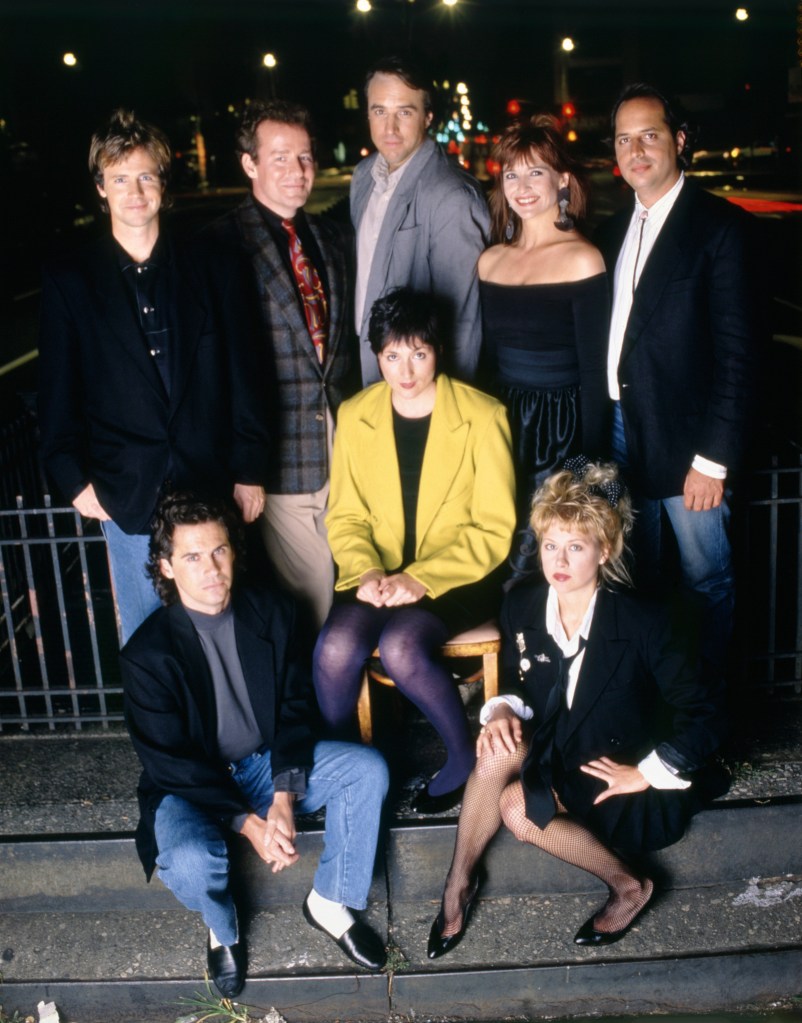
This cast ended up being popular with both critics and viewers because the show had finally gone back to what made it work so well in the seventies: a cast of relatively unknown professional comedians and improvisers who know how to be funny and know how to handle a live crowd on a stage. In fact this core group of cast members would go unchanged all the way from 1986 to 1989 when Mike Myers joined the cast. By that point, it finally felt like the show had life again.
 Entertainment Junkie Blog