

If you look at all the major inventions in the world of electronic communication from telephones to radio to television, the World Wide Web is kind of the ultimate culmination of all those things, to the point where the Web has almost made all previous forms of communication obsolete (mail led to email, phone calls led to video calls, radios led to podcasts, television led to YouTube, etc.) And yet as inevitable as the Web seems and as unimaginable as it would be to live without it today, someone had to come up with the idea for a worldwide communication service and figure out a way to make it simple enough for anyone to use, and that is not an easy task. So today I ask the question: who came up with the idea for the World Wide Web and how did we actually make it into a reality?
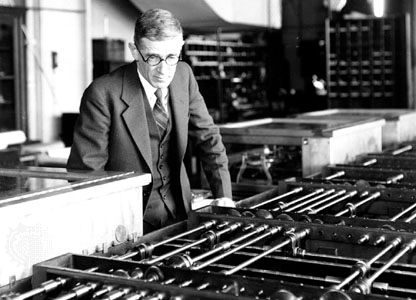
One major figure in the Web’s history was an inventor named Vannevar Bush. Bush was born in Everett, Massachusetts in 1890 and upon graduating from college began working for General Electric as basically a “test man,” which was what they called the person who inspected all the electronic equipment to make sure they were safe before they went out to the public. Although he later went back to college, studying electrical engineering at MIT and later receiving a doctorate at both MIT and Harvard. But he didn’t just return to college to study. He also accepted a job at his old college (Tufts College on the border of Medford and Somerville in Massachusetts) running the laboratory at the American Radio and Research Corporation which was an early example of a college implementing a broadcast system on their campus when it began operation in 1916. But after World War I broke out the following year, Bush started working for the National Research Council in order to develop technology that could help detect submarines by measuring disturbances in the Earth’s magnetic field, which worked.
Vannevar Bush went on to have a lot of success with electronics, helping develop things like the thermostatic switch (which is an invention that halts the flow of electric current when a certain temperature is reached), as well as the S-tube, which was a voltage regulator tube that enabled radios to operate on electric utility power rather than batteries, which is what led to Bush co-founding Raytheon in 1922, an industrial company that developed military technology. Bush first became involved with computers around this period, and in 1927 he invented an early analog computer that at the time was called a differential equalizer and was used to solve equations.
Side note: Vannevar Bush later became the dean of the MIT School of Engineering and an advisor to the U.S. Government on scientific matters, even working with Franklin Roosevelt during WWII. In fact, Bush was one of the most critical people responsible for convincing the U.S. Government to test the atomic bomb using Robert Oppenheimer’s calculations (you may remember Matthew Modine played Vannevar Bush in Christopher Nolan’s Oppenheimer).

Vannevar Bush was the person who invented the concept of memex, which many people view as the basis of the modern World Wide Web. As described by Vannevar Bush in his 1945 article for The Atlantic “As We May Think,” memex, which is short for “memory expansion,” is a hypothetical system of storing records through a mechanical device, which would serve as a personal filing system that could be consulted with groundbreaking speed and with which it would be possible to scroll back and forth through a trail of information. This was a concept that inspired many future engineers and eventually led to the creation of hyperlinks (the now common occurrence of clicking a link on one web page that transports you to another web page). Bush even envisioned this electronic storage system to emulate the way brains instantly link data through mental webs rather than through indexes. He even accurately foresaw the issue of information overload, predicting that several different POVs from several different people would stagger the scientific research attempted in this filing system (which is an issue that no one ever really solved).
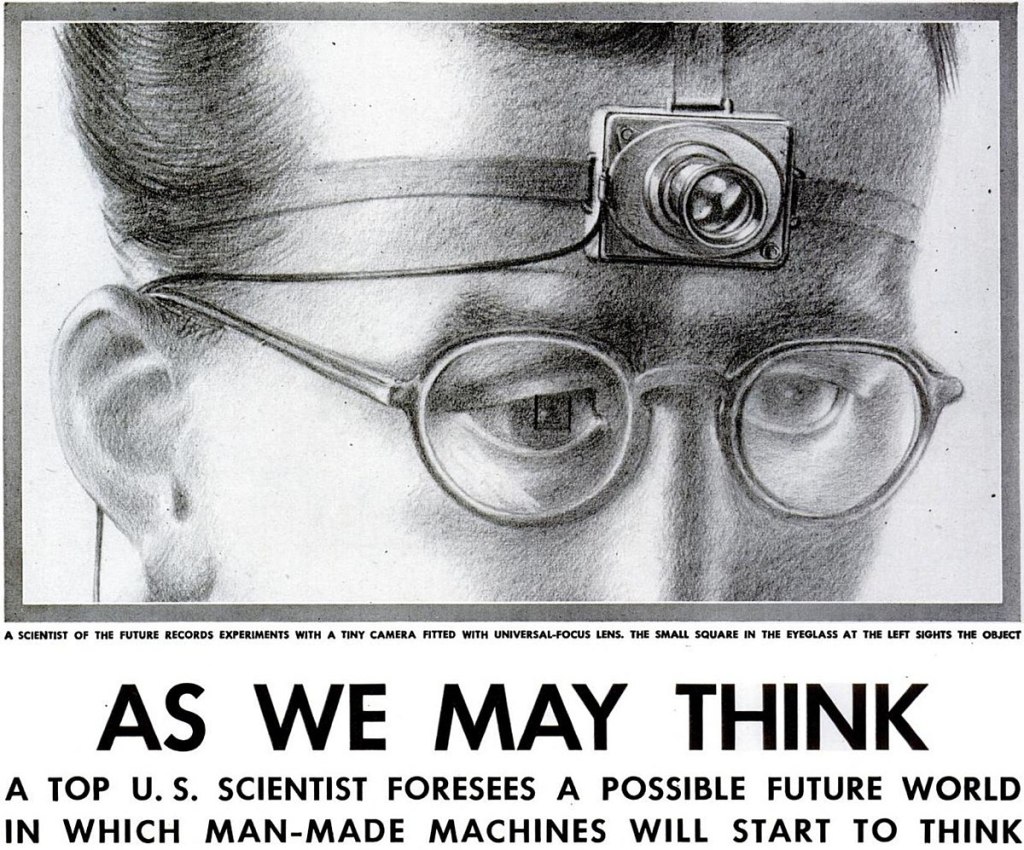
One of the people who read that essay in The Atlantic was engineer, inventor and computer science pioneer Douglas Englebart. Among his achievements, Englebart did work that led to the invention of the computer mouse alongside tech pioneer Ted Nelson, who coined the term “link” in the mid-1960s as well as the term “hypertext” (hyperlinks through text). The concept of hyperlinks and the work that Englebart and Nelson did in electronics would be important factors in the evolution of the Web. Englebart’s team would be the first to combine the idea of hyperlinks with Ivan Sutherland’s concept of graphical user interface, which allowed people to navigate a computer screen without the use of a keyboard, first through the use of a computer mouse and in later decades through touch screen navigation.

All of these things would eventually come together in 1989 thanks to Tim Berners-Lee, the man actually credited for inventing the modern World Wide Web. English computer scientist Tim Berners-Lee was a physics major who studied at The Queen’s College in Oxford during the 1970s (fun fact: while studying there, he was able to convert an old television into a computer). He got more involved in computer engineering upon graduation and eventually worked for the European nuclear research organization CERN. In 1980, upon his idea to combine hypertext with computer networking, he created a software project that served as a predecessor to the World Wide Web called ENQUIRE.
Berners-Lee has admitted that inventing the World Wide Web was largely a matter of taking pre-existing things like the Internet and hypertext and combining them with the concepts of other inventions like the Domain Name System and Transmission Control Protocol (which is basically the framework that connects all web communication). In addition to the World Wide Web itself, Berners-Lee invented the hypertext markup language (HTML) that defines the structure of web content, as well as the concept of the web address aka the uniform resource locator (URL), he initiated hypertext transfer protocol (HTTP) which was the foundation of data communication via the Web, and he devised and developed web browsers and web servers and fostered the World Wide Web’s development.


Berners-Lee published the first web site and web page on December 20, 1990 (pictured above). It was basically an information page about what the World Wide Web is. It exploded from there. These days everyone with a computer has access to the Web in their home and most people with a cell phone have access to it in their pocket.
By the way, while that first web page was eventually taken down, it has since been restored, and if you’re curious you can still visit it by going to this address: https://info.cern.ch.
 Entertainment Junkie Blog
Hello, you may enjoy some of these articles.
Best 🙂
The Wood Wide Web
https://scholar.google.com/scholar?hl=en&as_sdt=0%2C5&q=wood+wide+web&btnG=
LikeLike