

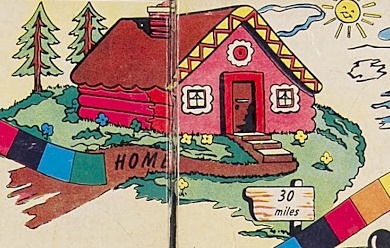
Most people know the board game Candy Land but just to explain the basic premise, the rules of the game are that players must navigate a colorful winding road and make their way out of a candy-themed land and back home by taking turns removing the top card from a shuffled deck to determine your point of direction. For example, if you pick up a red card, you move to the nearest red space. Meanwhile, you’re making your way through amazing (and tasty-looking) landmarks like the Gumdrop Mountains and the Lolli Pop Woods (and good luck avoiding the Cherry Pitfalls along the way). As each player progresses across the board, the first one to land on or pass the final square on the board and make it home is the winner. There’s no strategy involved here. It’s just a simple game aimed at kids where your only goal is to follow directions. What is a lot more interesting, however, is the backstory of the game’s creation.
In 1948, a schoolteacher named Eleanor Abbott was diagnosed with polio and admitted to a hospital in San Diego where she was surrounded by bedridden children who were suffering from the exact same disease. Understanding how painful and lonely it is to be paralyzed in bed with a debilitating disease, Eleanor Abbott was inspired to create a game to help entertain these kids, and during a difficult moment in their lives that game helped them take their minds off their suffering and focus on something positive. This was the very first iteration of Candy Land.


Candy Land was so popular among the kids in that hospital that Abbott was convinced she had something special on her hands and she decided to pitch the idea to board game publisher Milton Bradley. Milton Bradley loved it, they introduced the game to the public in 1949 and the public also loved it. Not just kids but adults. In fact the game was so popular with everyone that it became Milton Bradley’s most successful board game surpassing Chutes and Ladders and their biggest game at the time Uncle Wiggily. It also helped put Milton Bradley on the map and in the same league as Monopoly publisher Parker Brothers. The best thing about the game is that children as young as three can enjoy it because it doesn’t require any reading or writing skills. You just need to know the difference between the colors red, yellow, blue and green. It was the complete opposite of Monopoly because it was a short and easy game, although still high-stakes in a simplistic way.
Of course it came out with new iterations every decade while introducing new characters, elaborating on the game’s backstory and making small changes like turning Molasses Swamp into Chocolate Swamp in 2002, but Candy Land‘s core appeal never changed. It’s a board game that’s simple enough for anyone of any age to understand and it fosters imagination and fun rather than competition. Best of all it offered children who were homesick and stuck in hospital beds an escape into fantasy, and the game’s creator Eleanor Abbott never lost sight of why she made the game in the first place in the middle of all of its success. She donated all the royalty income she received from the game’s sales to charities dedicated to serving children in need.
 Entertainment Junkie Blog