

In 1989, a year after the success that Steven Spielberg and Amblin had with Who Framed Roger Rabbit, Spielberg founded his own animation studio called Amblimation. That studio went on to produce the hand-drawn animated films An American Tail: Fievel Goes West (1991), We’re Back! A Dinosaur’s Story (1993) and Balto (1995), before it ultimately went defunct in 1997 (only Balto had any real commercial success, although even that was due to home video sales rather than box office sales). It looked like a lot of talented animators were about to be out of a job, but after Spielberg co-founded his new studio DreamWorks Animation with Jeffrey Katzenberg and David Geffen, the team of animators assembled at Amblimation migrated over to DreamWorks to create films for that company instead. Katzenberg even managed to lure away some former Disney animators like James Baxter to animate at DreamWorks as well.
At the same time this was happening, DreamWorks was looking to sign a co-production deal with a computer animation company in 1995 (the same year that Pixar’s Toy Story became a huge success). That studio would end up being the California-based Pacific Data Images (PDI), whose team of animators previously created CGI special effects for such films as Terminator 2, Star Trek VI and Titanic. The first film DreamWorks Animation and PDI collaborated on was Antz (1998), a film that was originally pitched to Walt Disney Feature Animation back in 1988 under the name Army Ants. Jeffrey Katzenberg kept it in mind.

Antz tells the story of an anxious worker ant named Z (voiced by Woody Allen) who tries to save his ant colony from a corrupt general (Gene Hackman). In what would become a typical move for DreamWorks, the voice cast was full of arguably overqualified A-listers. In addition to Allen and Hackman, it featured the voices of Sharon Stone, Sylvester Stallone, Jennifer Lopez, Christopher Walken, Danny Glover and even Anne Bancroft as the Queen. It’s a pretty amusing and entertaining film and it almost felt like something for adults more than kids, but I appreciated how different it felt from other animated films at the time.

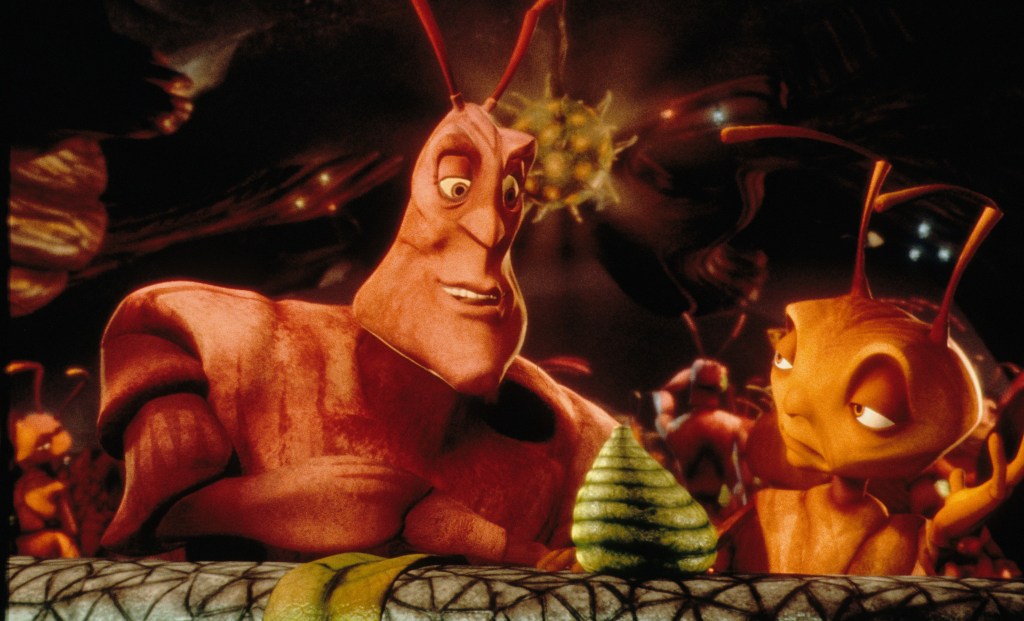

Something I always thought was funny back when I was a kid was the fact that Antz came out the same exact year as Pixar’s own ant movie A Bug’s Life, but little did I know that the reason behind that was actually kind of sinister. It is now widely known that Jeffrey Katzenberg, who Toy Story director John Lasseter kept in touch with after Katzenberg left Disney, intentionally made their own bug film in order to compete directly with Disney’s bug film (Katzenberg literally admitted this was true after Lasseter confronted him about it). Although Disney executives at the time were not exactly innocent either because they decided to target DreamWorks directly by scheduling A Bug’s Life to open on the exact same Thanksgiving weekend as DreamWorks Animation’s other film The Prince of Egypt, prompting Katzenberg to reluctantly move Prince of Egypt to December instead. Katzenberg got revenge by moving Antz, which was originally supposed to open in March 1999, up to October 1998 a month before A Bug’s Life came out.
Look, I know that the bitter and petty wars between greedy film executives is probably more interesting than anything I can say about this film, but if you ignore all that and just pay attention to the actual quality and artistic merit, Antz is a good film. It’s very different in tone and style from A Bug’s Life, but both films received good reviews and made big profits, so in the grand scheme nothing about the drama behind the scenes really mattered. Although I think the fact that Disney and DreamWorks feel so threatened by each other is a good thing. Competition between film studios is healthy and obviously good for consumers, animators and the economy in general, and after the winning streak Disney was on in the early nineties, it was only a matter of time before somebody put a target on their crown.

Antz wasn’t the only would-be Disney film that Katzenberg ended up taking to DreamWorks. Disney also missed out on Chicken Run and Sinbad, but The Prince of Egypt was Katzenberg’s passion project. He had always wanted to tackle the story of Moses, and once he left Disney and started his own animation studio, it would end up being the studio’s first feature film production.
The film was co-directed by Disney story artist Brenda Chapman, Amblimation producer Steve Hickner and Amblimation director Simon Wells. It featured a score by The Lion King composer Hans Zimmer, a soundtrack by Stephen Schwartz (who had previously written the lyrics for the songs in Disney’s Pocahontas and The Hunchback of Notre Dame) and a voice cast that included Val Kilmer, Ralph Fiennes, Michelle Pfeiffer, Sandra Bullock, Jeff Goldblum, Danny Glover, Patrick Stewart, Helen Mirren, Steve Martin and Martin Short.
The studio called in Bible scholars and Christian, Jewish and Muslim theologians to be as accurate and faithful to the foundation of the Old Testament as possible. Research trips to Egypt followed and the crew of artists and filmmakers ended up creating one of the best looking, most well-animated and most beautifully drawn animated films in a decade full of beautiful animated films.
One thing I appreciated about the film was that, like with Antz, the filmmakers made some creative choices that helped it stand out from typical animated films. A biblical epic, especially one that tells such a well known story like Moses freeing the slaves, is the kind of thing that Disney would have been too afraid to touch. I don’t even think the Disney of today is capable of making a good film about Moses because it’s not marketable enough for kids. But that’s exactly the point. Disney’s rivals should be making the kinds of dark and mature films that Disney would never make. This was not only reflected in the way the film was written but in the way the film was sold. The marketing for this made the bold choice to target adults rather than the kids that many adults probably assumed this movie was for. That was ultimately a risk that paid off. The Prince of Egypt did well in the holiday season and became a box office hit.

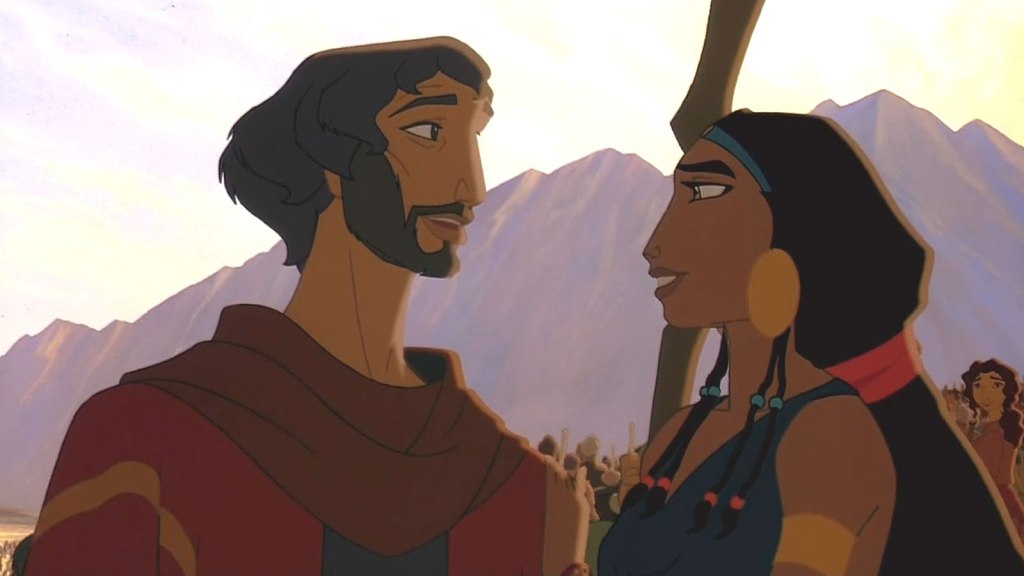

Critics praised the film, although a few acknowledged that it had more aesthetic appeal than emotional resonance. If you want my honest opinion (and I’m sure that you don’t), I am not as hot on this film as a lot of others are. Many people hail this as one of the best animated films ever made and I understand why they do. Roger Ebert was one of the film’s biggest champions, calling it one of the most beautiful and mature animated films he ever saw. Believe me, I get why people find an animated film with actual dramatic weight that is uninterrupted by wisecracking sidekicks or juvenile comedy refreshing, and in fact I wish the American animated film industry would have the courage to make films like this more often, but among the problems I had with this film, I (and again, a minority of critics) just found the characters too bland, I felt the story was too self-serious, and I thought it relied too much on songs. I sometimes wonder if the reason why this doesn’t resonate with me as much is because I’m not a religious person, but I don’t think there is anything inherently wrong with biblical adaptations. I just found this too melodramatic to strike a sincere emotional chord with me. Although don’t send a swarm of locusts after me. I still admire the film for its ambition, great artistry and reluctance to sugarcoat the Book of Exodus, as well as kicking off DreamWorks Animation in a memorable way.
The straight-to-video prequel Joseph: King of Dreams (2000) starring Ben Affleck received good reviews as well, even if many people were disappointed by how scaled back the story was when compared to The Prince of Egypt. It is also an anomaly as DreamWorks Animation’s only straight-to-video feature film in history to this day.

In my next blog I will talk about the moment DreamWorks Animation reached a whole new level of popularity, thanks to a certain green ogre.
 Entertainment Junkie Blog