

I like Sylvester Stallone’s path to success in Hollywood because he’s a guy who has experienced the lowest lows before reaching the highest highs. How he went from being homeless on the streets of New York City to starring in an Oscar-winning film just six years later seems miraculous but determination and good fortune also played a role.
The Italian-American Sylvester Stallone was born in the Hell’s Kitchen neighborhood of Manhattan in 1946 and even on the day he was born he faced adversities. Complications during his birth forced doctors to use forceps while delivering him, resulting in nerve paralysis of the lower left side of his face (the origin of his signature slurred speech and snarl). This caused bullies to target him when he was a child and Stallone coped with his struggles by doing two things: working out at the gym and acting.
He studied drama at the University of Miami, acting under the name Mike Stallone until 1970. It was in this period that Stallone was evicted from his apartment and willing to play any role in any production in order to make ends meet. After sleeping at the NYC bus terminal for three weeks, Stallone saw a casting notice for a softcore porn film called The Party at Kitty and Stud’s (1970). That film became Stallone’s first starring role (according to Stallone it was either make money this way or rob someone). The erotic off-Broadway stage play Score came afterwards and had a decent 23-performance run in 1971. Although Stallone still had to take odd jobs and by 1972 he almost gave up on acting.

He managed to book a number of unmemorable (and often unnoticeable) background roles in popular films like M*A*S*H (1970), Lovers and Other Strangers (1970), Bananas (1971), Klute (1971) and the Barbra Streisand comedy What’s Up, Doc? (1972), later finding bigger roles in The Lords of Flatbush (1974), Capone (1975) and Roger Corman’s Death Race 2000 (1975). But things began to change when he decided to write his own script.
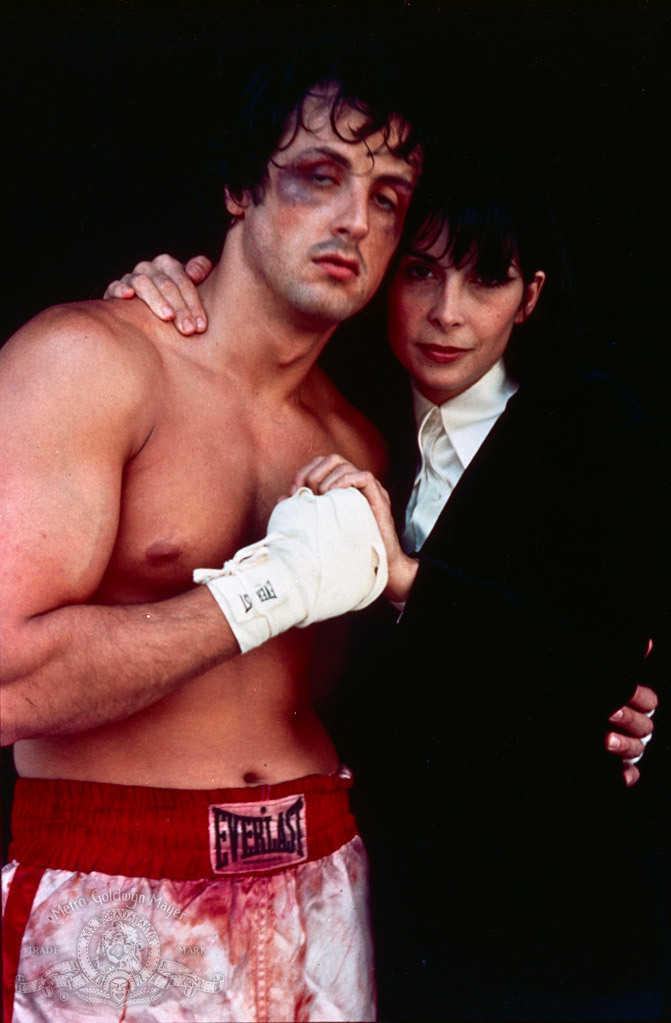
Stallone’s star-making sports drama Rocky (1976) about a down-on-his-lucky boxer from Philadelphia who gets a shot at the championship after heavyweight champion Apollo Creed (Carl Weathers) invites him to compete on the national stage was written by Stallone after he watched and was supposedly inspired by the 1975 championship match between Muhammad Ali and Chuck Wepner at Richfield.
While the television network ABC showed interest in turning the script into a made-for-TV movie, Stallone turned down that opportunity when they wanted to hire someone to rewrite the script. A lot of people in the film industry liked the script the way it was, but they turned it down when Stallone also refused to let anyone cast another actor in the lead role. United Artists initially wanted a big name like Robert Redford or Burt Reynolds to play Rocky but Stallone compromised by lowering the film’s budget in exchange for allowing himself to play the lead. Although even producers Irwin Winkler and Robert Chartoff were hesitant about releasing a film with an unknown lead.
The film would be directed by John G. Avildsen, who was primarily known that decade for making low-budget dramas, including Save the Tiger (1973) which won Jack Lemmon an Oscar.

The film premiered in New York City in the fall of 1976, and while it didn’t escape criticism for being somewhat predictable and schmaltzy, the acclaim was practically universal among critics, audiences and award bodies so those jabs were just a whisper in a chorus. The extraordinary commercial success of the film (it made $225 million total) is made all the more amazing due to how low the film’s budget was (less than $1 million), eventually becoming the highest-grossing film of 1976 and second only to Star Wars the following year, but no less a pop-cultural phenomenon.
Rocky was also nominated for nine Oscars, including one for Stallone’s acting and one for his writing, and the film won three of those Oscars for Best Film Editing, Best Director and Best Picture.
The boxing drama became the first in a series of films with Stallone writing and directing Rocky II (1979), Rocky III (1982) and Rocky IV (1985) and Avildsen returning to direct Rocky V (1990). 16 years later Stallone wrote, directed and starred in Rocky Balboa (2006) and reprised the role in the spin-off films Creed (2015) and Creed II (2018) starring Michael B. Jordan as Apollo Creed’s son Adonis Creed. That series is still going strong and so is Stallone, whose lasting success can be attributed directly to Rocky as well as Stallone’s determination to make the film his way and not the way Hollywood wanted him to make it. By now studios should know that audiences don’t care about big name stars as long as the story is good and the characters are memorable.
 Entertainment Junkie Blog