

I have not yet had the opportunity to write an article where I really dive into my love for the Japanese video game The Legend of Zelda: Link’s Awakening released by Nintendo for the Game Boy in 1993, and I promise that I will eventually. But right now I want to focus on a certain aspect of this game that deserves its own article, and that’s the soundtrack.
Before Link’s Awakening came out, the Zelda series has always had killer music, with Koji Kondo handling the soundtrack for the NES game The Legend of Zelda (1986) and its Super NES sequel The Legend of Zelda: A Link to the Past (1991), and Akito Nakatsuka handling the soundtrack for Zelda II: The Adventure of Link (1987), but in my opinion Link’s Awakening blew previous soundtracks out of the water, which is impressive seeing as how Link’s Awakening was the first handheld Zelda game, although unlike previous Zelda games, the story had a little bit more depth and emotional resonance, and that ambition with the story was reflected in the game’s musical ambition as well. Obviously since Game Boy was my first game system and Link’s Awakening was literally the first video game I ever played, it’s hard not to love all the music in this game based on nostalgic appeal. But the fact that all these songs are permanently embedded in my brain and I memorized all of them by the note means I’ve had decades of time to contemplate which songs are the best.
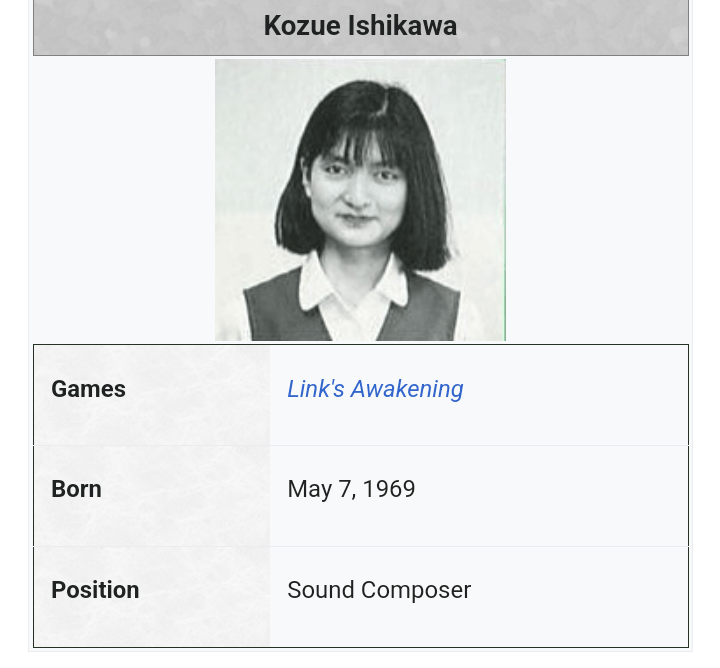
Before I get to my list, it’s important to give credit to the three composers responsible for the music in this game. A woman named Minako Hamano, a woman named Kozue Ishikawa and a man named Kazumi Totaka.
Minako Hamano was the composer behind many of Link’s Awakening’s most serious and dramatic songs, composing all the background music for the caves, castles and dungeons. Kozue Ishikawa was the one behind the more light-hearted music you would hear in forests, villages, shops and inside houses. Kazumi Totaka, who also served as the game’s sound programmer, seemed to handle miscellaneous things like the music for mini-boss battles, the music that accompanies various inhabitants across Koholint Island and the songs of the Musical Instruments of the Sirens. All these composers would have further success beyond Zelda. Hamano would go on to compose for many games in the Metroid series and a few Wario games, Ishikawa would go on to compose music for the Wario Land series on Game Boy as well as the Super NES game Star Fox 2, and Totaka would go on to compose the soundtracks for such Nintendo games as Yoshi’s Story, Luigi’s Mansion and Animal Crossing (including all of the expanded live performance versions of K.K. Slider’s songs) but Totaka is probably most famous as the voice behind Mario’s dinosaur friend Yoshi.


Here are ten tracks from The Legend of Zelda: Link’s Awakening that I personally love:
“Mysterious Forest” by Kozue Ishikawa
The moment you head north from Mabe Village and enter the Mysterious Forest while being greeted by the arrow-shooting warthog-like Moblins, the mood immediately changes as the music becomes more tense and antagonistic, as if you are being slowly surrounded by wild predators. The contrast with the cheerful tune of Mabe Village made this particularly effective.
“Shop” by Kozue Ishikawa
The music you hear when you enter the Mabe Village shop or when you enter the Witch’s Hut east of the Mysterious Forest is a piece of music that almost feels sordid and untrustworthy by nature with its music box-like jauntiness that goes into a hushed wind-down before winding back up into jauntiness again. Almost as if the music is reluctantly forcing itself to be cheerful. It’s only 15 seconds long but it’s got a lot of character.
“Tal Tal Mountain Range” by Kozue Ishikawa
The mountain range on the north side of Koholint Island, which serves a very important role in the game’s plot, has an appropriately epic-scale vibe that makes it sound like you are ascending to the heavens to confront a god (and based on the story of this game that actually isn’t too far off). Ishikawa absolutely nailed this tune, with clear inspiration from Koji Kondo’s Zelda theme.
“Hen House” by Kazumi Totaka
Less than 15 seconds long and yet the music you hear inside the Hen House on Tal Tal Heights is one of the most cheerful melodies I’ve ever heard in a video game. Kazumi Totaka might be a genius for the way he can instantly put you in a good mood with just a few simple notes.
“Bottle Grotto” by Minako Hamano
There are eight main dungeons you have to explore in Link’s Awakening, all with unique background music and all sinister in their own ways, but this tune for the second dungeon located behind a wall of flytraps in the Goponga Swamp is one I always appreciated for how understated it is. The feeling that you are wandering in the dark where a ghost could appear at any second and start chasing you is strong with this composition.
“Key Cavern” by Minako Hamano
Probably the least subtle and most sinister music of all the eight dungeons, this one really brings to mind walking into the belly of the beast when it comes to setting the mood, but it does jump back and forth from loud moments to quieter moments pretty liberally, which only makes it even more unsettling.
“Face Shrine” by Minako Hamano
This one is kind of a cheat because there are actually two Face Shrines in this game, each featuring music with very different vibes, but both melodies are fairly identical. The music in the Southern Face Shrine, where Link goes to learn more about the history of Koholint Island, is more slow-paced and contemplative. The other Face Shrine in the north is actually the sixth main dungeon in the game and the music here is a little more energetically paced but also more hushed and eerie. But I love both songs equally and they both do their jobs setting an appropriate mood.
“Ballad of the Wind Fish” by Minako Hamano
The first character in the game Link meets after waking up from his shipwreck and finding himself on Koholint Island is a girl named Marin who ends up teaching Link a song called the “Ballad of the Wind Fish” which Link can learn to play once he obtains an ocarina. The Wind Fish the song is referring to is actually an inhabitant of Koholint Island and both the song and the Wind Fish serve important purposes in the game’s story, and in many ways this is the most important song in the game as well as being the most beautiful song in the game. It shows up at various points throughout your adventure and kind of serves as the game’s unofficial theme song, but no matter when it shows up it never fails to deliver on the emotion it aims for. One of Minako Hamano’s masterpieces.
“Manbo’s Mambo” by Kazumi Totaka
The “Ballad of the Wind Fish” is not the only song Link can learn to play on his ocarina. At one point in the game after you obtain the flippers and gain the ability to swim, you will meet a giant talking fish named Manbo who teaches Link “Manbo’s Mambo” which grants you the ability to teleport. The song is classic Kazumi Totaka. Cute, simplistic and very reminiscent of something you might hear in Yoshi’s Story. Of course it’s not an amazing song or anything. It almost sounds like something a child could have written. But that’s part of its charm.
“Frog’s Song of Soul” by Kozue Ishikawa
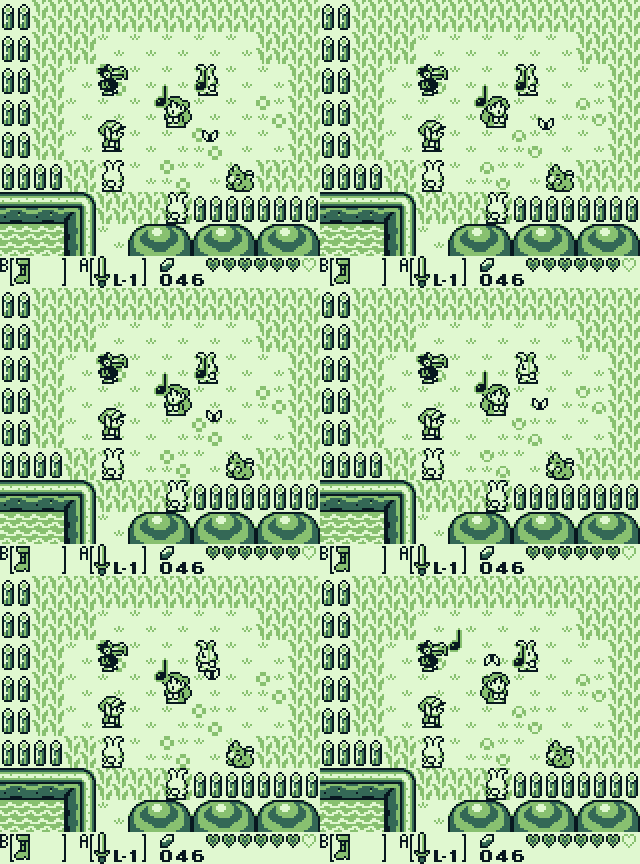
The third and final song Link learns to play on his ocarina, the “Frog’s Song of Soul,” is taught to you by Mamu the frog king who croaks it to you alongside his two frog background singers in a flashy Broadway-style fashion that is memorably gaudy but still pretty catchy. The song grants Link the ability to “make things feel alive.” And yes, I mean it will literally raise the dead.
 Entertainment Junkie Blog