

As someone who loves film and is immersed in modern film culture, I see tons of takes about the film industry from critics, audiences and fans all the time, and a common complaint I see is that Hollywood is getting less bold and creative and more formulaic and risk-averse. That’s certainly true to an extent, and I know that plenty of brilliant and creative films still get released in theaters every year (not just the stuff distributed by A24 but also big studio stuff like Barbie and Killers of the Flower Moon), but it is also much harder to convince a studio executive to greenlight something creative than to convince them to greenlight something similar to what has already been done before, a side effect of the ballooning budgets and profits of the blockbuster era that began in the seventies. Although there was a fascinating period in film history between the releases of Easy Rider and Jaws that took place in the late sixties and early seventies where Hollywood almost completely let directors call the shots creatively, and the creative freedom granted to them is partly why so many American films from the seventies are some of the biggest masterpieces in Hollywood history. It was a short period of unbridled creativity the likes of which Hollywood will likely never see again, and the two films most responsible for bringing that period about were Bonnie and Clyde and Easy Rider.
To understand how we got there, you have to understand the poor state of the American film industry in the late sixties. The studio era of the 1930s and 1940s was over, and people were not going to the movies as much as they used to. The reason why you started seeing corporations like MCA buy Universal and Gulf + Western buy Paramount was because the studios could not sustain themselves anymore. And a big reason why studios could not financially sustain themselves after the 1950s was not just because of the rising popularity of television but because the old guard of the film industry, a group of producers who was used to making entertainment for WWII-era audiences, was completely out of touch with baby boomers.
The 1960s were possibly the most transformative decade in history thanks to the counterculture revolution but the entertainment industry was very behind in the times and completely unprepared to deal with a generation that said things like “Drop acid, not bombs.” Not that the Vietnam War was the only reason why young people mistrusted the old establishment. The film industry was struggling to attract audiences in this decade partly because it felt like Hollywood was out of touch with reality. The sixties were a decade when your boyfriend could literally be drafted to fight overseas in a war that you, he and the vast majority of baby boomers were largely against, so you might not exactly be in the mood to watch Julie Andrews sing on a mountain top. People just did not want to watch musicals and fantasies anymore, and by 1971 the movie industry was the least profitable it had ever been.
However the seeds of New Hollywood had already begun to grow by this point. Out of the disillusionment and rebellious nature of the post-war generation came many brilliant directors like Stanley Kubrick, John Cassavetes and Mike Nichols who made independent and sometimes self-funded films that spoke to audiences who craved something a little more adventurous and a little more real. Films like Dr. Strangelove, Faces and Who’s Afraid of Virginia Woolf? were not merely entertainment but were also actually trying to say something and had distinct creative voices behind them.

It was certainly not easy for mavericks like Warren Beatty to have the door to their creative vision opened by the gatekeepers of old Hollywood. Beatty was not a baby boomer. He was someone who worked within the studio system. But he still understood what made a good movie and he wasn’t afraid to tell Jack Warner when the script of a Warner Bros. film sucked. Despite being distributed by Warner Bros., Jack Warner never really understood the appeal of Bonnie and Clyde (1967), which only underscored the fading relevancy and old-fashioned nature of Jack Warner. But the stubbornness of old Hollywood and their unwillingness to change the way they made films left young filmmakers no choice but to be rebellious, and if Warren Beatty hadn’t broken the rules and fought to get Bonnie and Clyde on screen, his career might have looked very different. In fact Beatty had as good a reason as any to be disillusioned by Hollywood. He was the guy who came up with the idea for the 1965 screwball comedy What’s New Pussycat? and he was originally going to star in it before producer Charles K. Feldman replaced him with Peter O’Toole. Beatty vowed to always be in control of his own movies from that point forward.
Bonnie and Clyde was certainly a movie that resonated with a large chunk of the counterculture crowd. In the era of draft dodging, being an outlaw was more romantic than it had ever been with mainstream audiences, and producer and star Warren Beatty was also smart enough not to hold back with the movie’s violence. The sixties were a decade of war and political assassinations. Toning down violence meant you weren’t seen as realistic, and authenticity was everything (because baby boomers were tired of the government lying to them). Bonnie and Clyde was in some ways the first “seventies” film to be released in the sixties. It was the first of its kind and a watershed Hollywood picture that depicted unapologetic criminals thumbing their noses at the establishment, which is of course why many old Hollywood producers despised it and why many audiences loved it.
Despite WB’s efforts to limit the film’s reach across theaters due to a lack of faith in its commercial appeal, Bonnie and Clyde was a huge success and it would end up signaling a big change in what constitutes a Hollywood film, in terms of the kinds of things they romanticized (in this case outlaws) and the kinds of things they demonized (in this case authority figures like local law enforcement and even one’s own parents). Sure, you can argue that Hollywood films have always been violent, but whereas James Bond shot at international terrorists, Bonnie and Clyde shot at the cop next door!
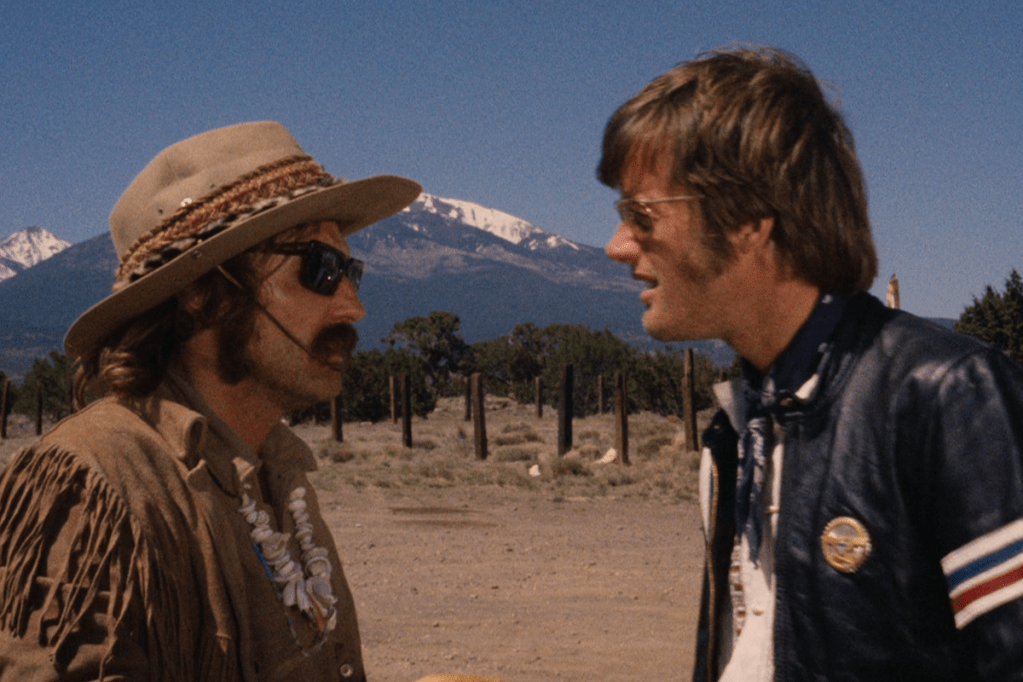
Just like Warren Beatty with Bonnie and Clyde, Dennis Hopper worked both behind and in front of the camera for Easy Rider (1969), a movie that also spoke to the counterculture movement and its disdain for authority figures. Dennis Hopper very deliberately viewed the film as an allegory for how American freedom is mostly an illusion, with the ending of the movie representing how fleeting that freedom can be.
Easy Rider’s huge box office success signaled to the old guard even more than Bonnie and Clyde that the counterculture movement was no longer fringe but now mainstream, and it officially signaled to Hollywood studios that they didn’t know what they were doing. Cleopatra and Camelot failed, but Easy Rider is a success?? It was finally time for Hollywood to admit that they were out of touch, so they gave directors more opportunities to do what they wanted because they thought the directors knew something about appealing to the mainstream that the studios did not, and this led to what many perceive as Hollywood’s new golden age of the 1970s. Of course, it didn’t take long for directors to wake up from this dream of unlimited creativity.
At the time, Dennis Hopper said that he saw the old studio system as a thing of the past and that the Hollywood studios should just focus on being distribution companies for independent producers from now on. In some ways this is exactly what happened, but not in the way that Hopper and his filmmaking peers romanticized it would. For starters, the era that began with Easy Rider where film studios would let young filmmakers run the show because executives were unsure of how to appeal to counterculture audiences lasted only about two years, and by the mid-1970s, Hollywood would once again be thriving at the box office thanks to films like The Exorcist, The Sting, American Graffiti, The Towering Inferno and Jaws. Meanwhile, as Jaws took off and transformed Hollywood into a blockbuster and sequel factory, the appeal of New Hollywood began to wane, with directors like Peter Bogdanovich, Mike Nichols and even The Godfather and Apocalypse Now director Francis Ford Coppola never really riding high as they did by the time the seventies ended.
But that period when directors were given free reign? Some of the most bold and unbridled storytelling came out of it. Robert Altman directed M*A*S*H (1970), McCabe & Mrs. Miller (1971) and Nashville (1975); Hal Ashby directed Harold and Maude (1972), Shampoo (1975), Coming Home (1978) and Being There (1979); Peter Bogdanovich directed The Last Picture Show (1971), What’s Up, Doc? (1972) and Paper Moon (1973); Francis Ford Coppola directed The Godfather (1972), The Conversation (1974), The Godfather Part II (1974) and Apocalypse Now (1979); William Friedkin directed The French Connection (1971) and The Exorcist (1972); George Lucas directed American Graffiti (1973) and Star Wars (1977); Martin Scorsese directed Mean Streets (1973), Alice Doesn’t Live Here Anymore (1974) and Taxi Driver (1976); Steven Spielberg directed Jaws (1975) and Close Encounters of the Third Kind (1977). These were extraordinary films that were unlike any film that came before in their ambition and disposition. It just wasn’t a sustainable system and there were several reasons for that.
People like to blame Spielberg and Lucas for the failure of New Hollywood since they were the guys who directed the first blockbusters, but the massive success of Jaws and Star Wars was more like a symptom of a problem than the cause of a problem. Once Hollywood became eaten by giant corporations, they began thinking less like a place for creativity and more like a business, and if all you care about is making money, funding a director’s passion project becomes an unrealistic proposition. It certainly didn’t help that the passion projects of directors were not always successful at the box office, with Heaven’s Gate (1980) being the most famous example and a film that directors like Scorsese and Coppola have previously blamed for killing the New Hollywood age. Of course, no filmmakers are really to blame for this. The real people responsible for the end of New Hollywood and the reign of blockbusters are CEOs and audiences, because they are the ones with the real influence on Hollywood trends. Only Spielberg and Scorsese were really able to continue their huge success rate past the eighties, but for a brief moment before Barry Diller, Michael Eisner and Wall Street killed the artistic spirit of Hollywood, these auteurs were the kings of the world and the voice of a generation.

 Entertainment Junkie Blog