
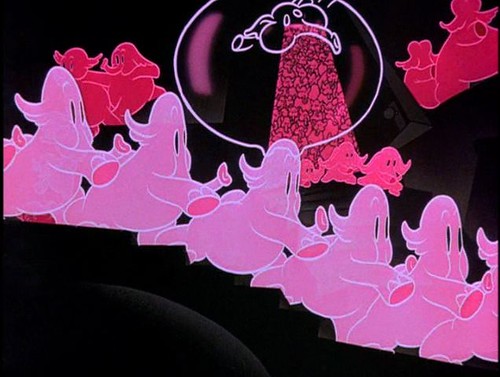
If you ever ask me what my all-time favorite scene from any Disney movie is, my choice will always be the “Pink Elephants on Parade” sequence from Dumbo (1941). A sequence directed by Norm Ferguson, brilliantly animated by Hicks Lokey, Karl Van Leuven and Howard Swift and accompanied by a song with music by Oliver Wallace and lyrics by Ned Washington.
The hallucinatory march of the Pink Elephants begins after Dumbo and Timothy Q. Mouse inadvertently become intoxicated after drinking water spiked with champagne. The clever thing about the scene’s inclusion in the film is that it actually serves a plot purpose: after Dumbo and Timothy awake from their Technicolor pachyderm-feuled nightmare while sitting atop a tree, they come to the realization that Dumbo has the ability to fly. As for how Disney’s artists would bring that nightmare to life, their only direction was to let their imagination run wild for five minutes. The resulting sequence has never been topped by a single scene from any other animated film in existence in terms of the artistry, creativity, lunacy and pure entertainment put on screen. And if you think I’m wrong, please tell me which other scene matches it, because I’m pretty sure it does not exist.
But on top of everything else I’ve said, the scene also manages to be effective as an eerie piece of surreal expression, almost like a standalone film within a film that allowed Disney’s team of artists to stretch their creative muscles by dabbling in modernist horror. And in my opinion, there was no better place to put it than right in the middle of their cute circus movie about a baby elephant.
Walt Disney was of course never afraid to scare audiences or go in eerie directions, much less so than the safer and less experimental Disney of today. In fact he often relied on scary scenes to enhance the overall story and to make the happy endings feel more satisfactory. Walt Disney was totally conscious of the fact that if you don’t venture into the darkness, you won’t appreciate the light as much. And if you look at his early films, including many of the Silly Symphonies, you can see that this has been a tried-and-true storytelling formula he loved to use.
I’ve criticized Disney’s films before for sometimes being overly sappy, and this goes in the opposite direction too with scary moments that can sometimes be overly melodramatic. But when the writing, direction, animation and music come together perfectly, these can be some of Disney’s most memorable scenes. Who can forget the horror-inspired scene from Snow White and the Seven Dwarfs (1937) when the queen transforms herself into a hag, or the traumatic realization that human boys are being turned into donkeys in Pinocchio (1940)? Okay, admittedly, these scenes never really “scared” me, because even when I was a kid I knew movies aren’t real. But they still could do a good job getting under my skin and creeping me out. In fact if I had to list the creepiest Disney films I’ve ever watched in addition to Snow White and Pinocchio, I would probably say Fantasia (1940), Education for Death (1943), The Adventures of Ichabod and Mr. Toad (1949), Alice in Wonderland (1951), Sleeping Beauty (1959) and, oh yeah, Return to Oz (1985). The creepiest Disney film of them all. And by the way, that film was released the same year as The Black Cauldron (1985), which was seen by many people as being too dark and scary for a Disney movie and, just like Return to Oz, bombed at the box office. They never really ventured very far into the dark again after that, and it’s not hard to see why.
Contrary to what some people may assume, this is not why Touchstone Pictures was created. That had more to do with CEO Ron Miller’s desire to have more latitude in their film selection and not be held back by the family-friendly nature of the Disney brand. Although when Michael Eisner became CEO he did do a lot of strategizing with the Disney and Touchstone labels when it came to releasing films, including Henry Selick’s The Nightmare Before Christmas (1993) which Eisner labeled a Touchstone movie (perhaps out of fear of repeating the The Black Cauldron’s mistake) before it became a huge success and Disney started proudly associating with it and continued to work with Nightmare Before Christmas producer Tim Burton on tentpole films like Alice in Wonderland (2010). Even Pirates of the Caribbean: The Curse of the Black Pearl (2003) almost became a Touchstone film out of fear that it would be too scary for kids. But like I said, Disney rarely pushes the envelope like they used to, in part because they don’t have to anymore due to the company’s continued association with adult-oriented labels that in the past has included Touchstone Pictures, Hollywood Pictures and Miramax and now includes 20th Century Studios, Searchlight Pictures, ABC, FX and Hulu (the legacy of great Disney animation is alive and strong with Solar Opposites). At the same time, ever since the eighties and the proliferation of Touchstone, Walt Disney Pictures itself has become one of the safest and least creative studios when it comes to their live-action output. Especially in recent years with the overabundance of live-action remakes.
Tim Burton even directed a live-action Dumbo remake with a watered-down version of the Pink Elephants sequence, and I can’t think of a better place to end this article than on that sentence because it brings me full circle and emphasizes my point perfectly.
 Entertainment Junkie Blog